
The Best Age to Start Karate in 2026

When should a child start karate? In 2026, many karate schools accept kids as young as 3 to 6, and age 6 is often a strong “ready for structure” milestone. Still, there’s no magic birthday that fits every child.

The best age to start karate depends on maturity, attention span, and coordination, not the calendar. Below is a practical breakdown by age group, so you can choose with confidence and skip the pressure.

What matters more than age: 5 readiness signs to look for

Think of karate like learning an instrument: early exposure helps, but “ready” matters more than “early.” These five signs usually mean your child is ready now (or close):

  • Follows 2-step directions: “Line up, then hands to your sides.”
  • Stays with a group: Can participate without wandering off every minute.
  • Basic balance: Can hop on one foot or walk heel-to-toe.
  • Handles gentle correction: Doesn’t melt down when coached.
  • Bathroom independence: Especially important in classes for younger kids.

If a couple of these are shaky, it doesn’t mean “no.” It means “not yet,” or “start with a slower class.” A trial lesson is also a smart safety check: the right program should match your child’s stage, not force them to keep up.

How to use a trial class to confirm fit

In one class, watch for listening, excitement versus overwhelm, and whether your child can rejoin after distractions. Notice the coach’s tone: clear, calm, and kind beats loud and harsh. Also watch how the school supports shy or wiggly kids. Good instructors redirect without shaming.

Best age to start karate by age group: what parents should expect

Karate should look different at different ages. The goal is steady growth, not rushed belts. Also, there’s no “too late” age to begin.

Under 3: why most schools say “wait,” and what to do instead

Most dojos don’t take toddlers because focus, coordination, and potty needs can derail class. Try parent-child movement classes, swimming, and playground balance games. At home, practice “line up, freeze, listen” like a fun game.
Ages 3 to 5: a great start for fun, focus, and coordination (not perfection)

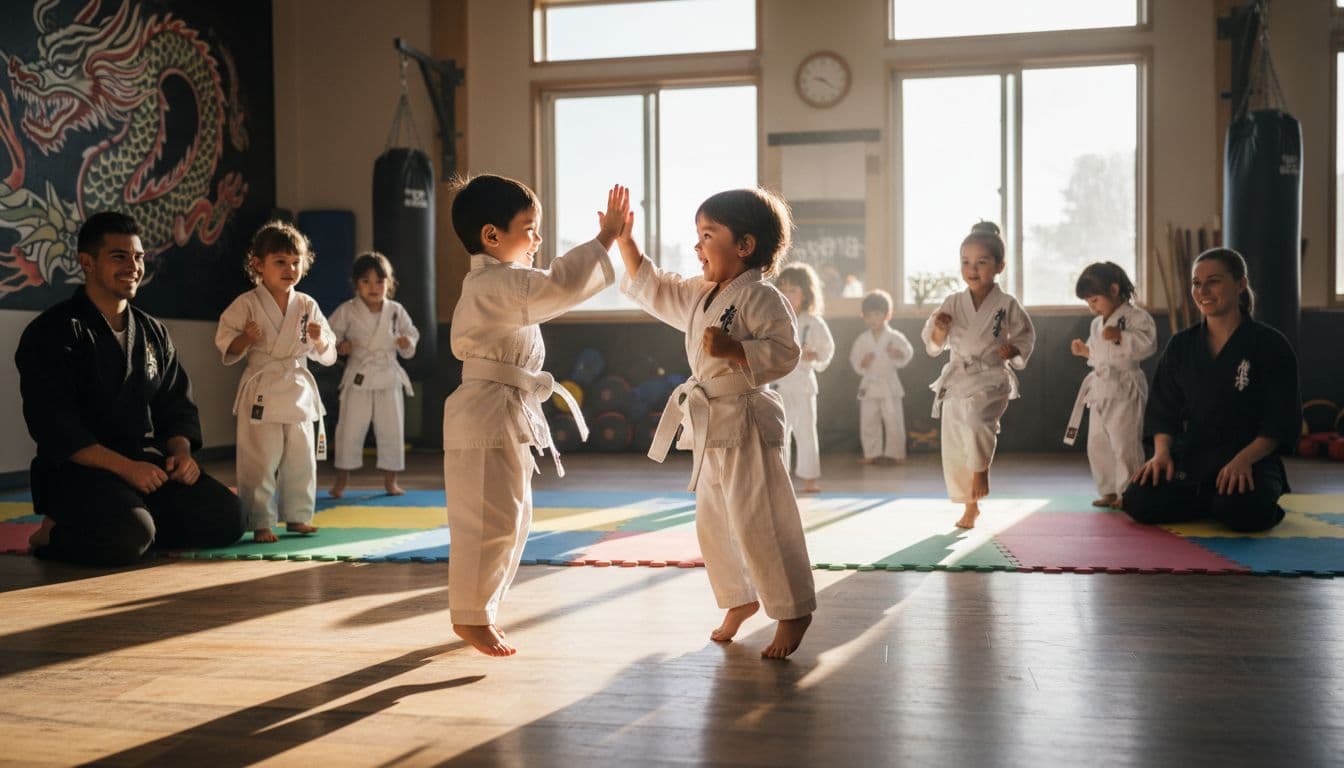
A vibrant karate dojo filled with happy children aged 3 to 5 wearing white gis, engaged in playful karate games like balancing and punches, with kind instructors guiding them amid colorful mats and warm light. Preschoolers practicing simple karate games in a dojo (created with AI).

Good preschool karate uses short classes, games, basic stances, rolling, balance work, and simple respect phrases. Big wins here are motor skills, confidence, and learning to take turns. The main challenge is attention span, so overly strict or long classes can backfire.
Ages 6 to 10: the sweet spot for structured karate and steady progress

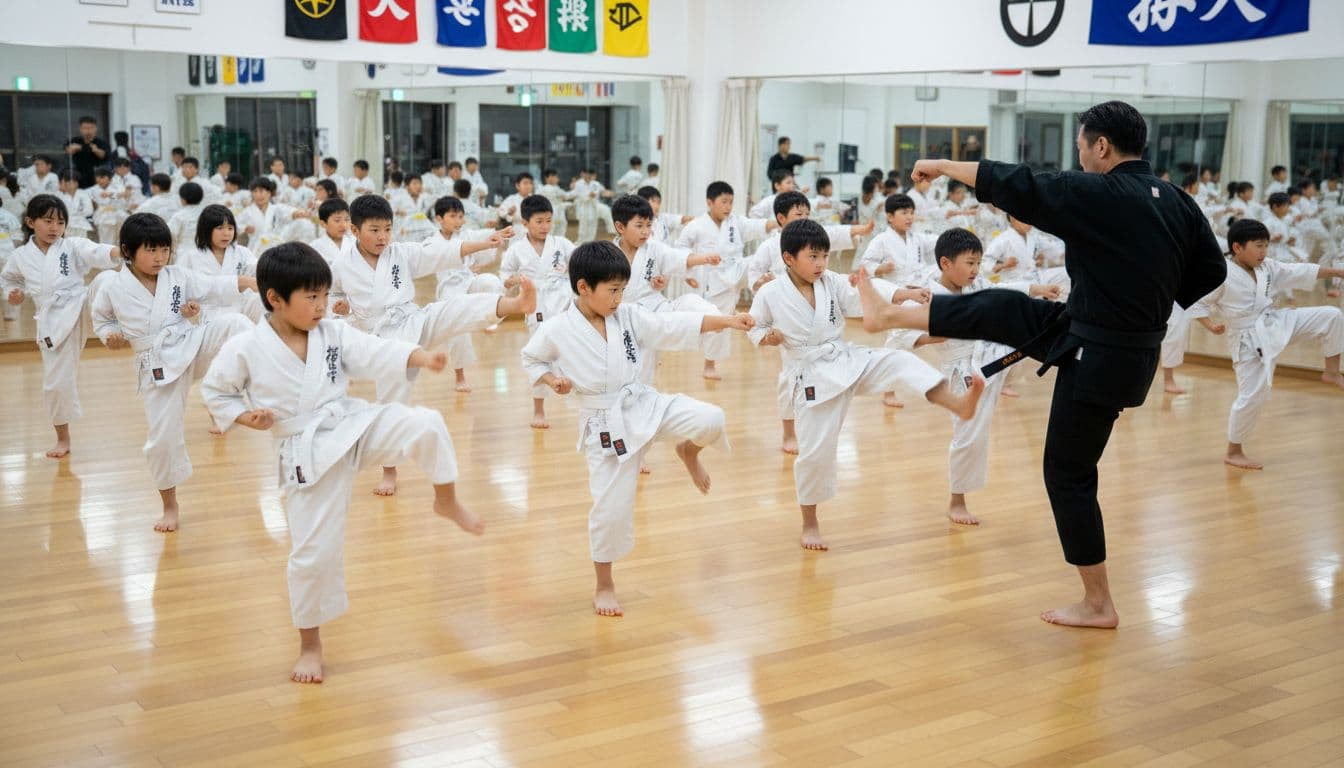
Children aged 6 to 10 in white gis perform synchronized front kicks and punches in a spacious karate dojo, led by a black belt instructor amid mirrors and motivational banners. School-age kids practicing structured karate drills together (created with AI).

Around age 6, many kids can focus longer and control their bodies better, which makes “real basics” click. Expect belts, drills, forms, safe partner work, and simple goal setting. One caution: too many classes, too soon can cause burnout. Progress should feel challenging, not exhausting.

Ages 11 and up: starting late is normal, and can be a big confidence boost

Tweens and teens often thrive with fitness, stress relief, and clear structure. If they worry about being behind, ask about beginner-friendly classes and supportive instructors. A good dojo helps older beginners feel welcomed on day one.

Picking the right karate school in 2026 so your child enjoys it and stays safe

Look for age-specific classes, clear safety rules, and controlled contact. Ask about mats, warm-ups, and supervision during partner drills. Staff should be screened, and the culture should feel respectful and welcoming.

Be wary of unrealistic promises (like “black belt fast”). A solid school communicates goals, handles sparring carefully by age, and can explain how they respond to bullying concerns and injuries.

Questions to ask before you sign up

  • How big is the average class?
  • What’s the beginner path for my child’s age?
  • When does sparring start, and what contact is allowed?
  • How do belt tests work, and how often are they?
  • What gear is required, and what does it cost?
  • How do you support shy kids or kids with high energy?

Conclusion

Ages 3 to 5 are great for playful foundations, ages 6 to 10 often fit structured learning best, and 11+ is still an excellent time to start. The next step is simple: pick a school with age-right classes, book a trial, and decide based on readiness and enjoyment, not pressure.

Action Karate Logo
Action Karate, Huntingdon Valley, PA has been teaching martial arts since 2005. We have trained thousands of children and adults over the years, instilling in them our values of CONFIDENCE, KNOWLEDGE, HONESTY and STRENGTH.
© Copyrights Reserved 2025 Action Karate – Powered by mediaEXPLOSIONinc.

In the realm of infrastructure reliability, a professional stresser solution proves invaluable. System engineers from all sectors depend on these services to evaluate performance limits before they create production failures.

The modern free ip stresser has to deliver a comprehensive selection of load scenarios covering UDP floods. This range makes it possible for hosting providers to properly validate how their systems perform during saturation events.

Based on network engineering research, hosting providers that conduct periodic resilience verification with a proven ip stresser track far fewer unexpected failures as opposed to teams that neglect proactive load testing.

Beyond conventional performance evaluation, professional-grade free ip stresser platforms typically include latency histograms. These metrics let engineers engineers to do more than just inject load but also collect actionable intelligence which directly strengthen load balancer tuning.

For teams running a web application, with a ip stresser from a reputable provider provides the most representative simulation of production-level burst traffic situations. Establishing systematic stress tests ahead of a live attack defines of responsible platform engineering.

Selecting the right ip stresser hinges on a few critical requirements: the attack types available, the throughput it can generate, how detailed the reports are, and most importantly whether the load represents production scenarios. Platforms like a professional ip stresser as well as a proven network testing service address all of these requirements enabling production-grade DDoS readiness testing.

In real deployments, platform operators who regularly use a stresser observe that the data collected reliably drive optimized firewall rules. This validation loop linking regular stress evaluation and system improvement is the hallmark of world-class deployments from infrastructure that buckles during production traffic.

Ultimately, delivering enterprise-grade network infrastructure is achieved through proactive breaking-point analysis. Tools like stresser alongside stresser exemplify the modern SRE playbook. Establishing a disciplined stress testing schedule powered by industry-recognized stresser tools is a baseline for reliability — it is the foundation for how world-class systems earn user trust.